I really don't want to write this blog post. So, it's offered in a spirit of
polite resignation.
A couple of days ago a friend and current board member of the
Python Software Foundation (PSF) reached
out asking, "Hey, we want to feature some CSA awardee's pictures in the PSF
blog post, do you want to give me a picture of you to use?" CSA is the PSF's
Community Service Award,
of which I was a recipient millions of years ago.
The short answer is, respectfully, "no, and please don't feature me".
The longer answer, which I'm sharing here so I don't have to keep repeating
myself, is more complicated.
It is a privilege that many remarkable folks in the Python community are my
friends. They are a diverse and international bunch who bring to life a
multitude of experiences, cultures and outlooks. To say they are very different
(despite sharing common cause in Python) is an understatement. Their unique and
multifarious gifts are something special to cherish and, just like a
symphony orchestra, when taken together their whole is vastly greater than the
sum of their parts. My world is enlarged by my fulfilling encounters with these
folks and I am thankful that I am able to learn, grow and flourish through our
interactions together.
Yet, there is a dark side to the Python community.
As I have extensively explored elsewhere in this blog
(here, here and
here), I no longer participate in the UK
Python community. I do not feel safe or welcome, nor do I trust the UKPA's
presence in that community. Through conversations with many of my Python
friends, I can say with certainty that my experience in the Python community
is NOT unique.
A case in point...
In a triggering turn of events, over the past two months I have watched with
increasing horror as important parts of the Python community have unravelled
into what can only be described as a cesspit of hurt and dysfunction.
Factionalism is rife, heels have been dug in and the positions of others have
been misrepresented.
It saddens me deeply that the PSF are at the centre of (although not the only
participants in) this unfortunate and destructive turn of events.
Stepping up and volunteering in an open source community is hard
work. Often things go wrong and complicated situations arise so nuance, self
reflection and compassion are key to affirmative growth and collaboration.
Herein is the nub of our sorry situation.
The PSF appears
unable to acknowledge
both the plurality of dispositions in our community nor that the Python
community is often a deeply unpleasant place. I believe the first step to
effectively engage with such unpleasantness is to acknowledge that it exists
and then, in a deeply uncomfortable and tricky process, explore it together via
mutual respect, compassion and honesty. Eventually, perhaps, reconciliation
and trust can flourish. Rather than corporate platitudes, shallow musings and
tragic exclusions, I hope the PSF take a long hard look at themselves and
honestly re-evaluate their presence and the behaviour they embody within the
community. The alternative is the disintegration of Python into something akin
to the
"People's front of Judea" segment
of Monty Python's "Life of Brian".
I sincerely hope the PSF find ways to listen, show leadership and engage with
compassion. Only then can hurt be healed, collaboration re-established and
trust regained. I'm not so much trying to call out the PSF as to call them in ~
into a more enlarged and empathetic approach than has hitherto been apparent to
me.
If you doubt my words are true, read those problematic discussions and ask
yourself... does the Python community feel healthy and happy at this moment in
time?
This is difficult work. We can only do this work TOGETHER. We can only
work together if problems are acknowledged, differences respected and mutual
trust encouraged. Currently, alas, I see no such hoped-for engagement from the
PSF. For no amount of PR gobble-de-gook, high handed pronouncements or a witch
hunt will fix such a deeply broken situation.
Until things change to a more compassionate and less performative approach, I'd
rather not be involved (thank you very much).
Peace.
Addendum (2024-09-18)
I want to publicly acknowledge and thank my PSF board member friend. They
graciously responded, "I am sorry you feel so bad about the situation. I
understand your decision, no hard feelings." This embodies the best of the
Python community. Bravo.
I want to add that I don't feel bad.
I feel disappointed.
The unravelling in the Python community has caused me to pause and wonder how
the actions taken by the PSF represent the sort of community we want to be. My
hope has always been for a tolerant appreciation of the subtleties of context,
a focus on open minded mutual care and understanding, along with a large dollop
of big hearted compassion and a sense of fun.
Alas, recent PSF activity is hard to reconcile with such a hope.
There appears to be confusion between things that should be celebrated (like
passion, humour, honesty, differences of culture and diversity of experience)
and things that are genuinely problematic (like deliberate bad-faith activity
or intentionally diminishing, dehumanizing, harming or harassing others).
The PSF tragically excluded folks acting in good faith. The PSF doubled down on
the "welcoming community" narrative at the exclusion of acknowledging things
are awry (and that the PSF has some part in this unfortunate situation).
Frustratingly to my eyes, the PSF's corporate "PR" diminishes the carefully
cultivated good standing and authenticity of the organisation. Remember when
Python was fun? Me neither... :-/
Open source is hard work. Everyone involved wants Python to flourish. I have no
doubt we all mean well. My disappointment is that the PSF promote ideals in a
way that appears to embody their polar opposite. Furthermore, their actions
appear to suggest the PSF no longer stands for the community... the PSF stands
for the PSF.
I hope my words stimulate a more reflective, humble and heartfelt outlook;
otherwise I fear we'll continue to decline into yet more fractious schisms.
Reconciliation is something we can only do together, and it won't be easy.
PyCon US 2024 has been and gone. It was mostly
lovely, and huge thanks to the team of volunteers who made it happen.
I was privileged to help plan the
web assembly summit
with my buddies Brett and Fabio. We paid close attention to cultivating a space
where folks could meet, learn and build the connections needed to grow our
nascent WASM community. I enjoyed paying attention
to the three excellent talks about PyScript given by
my friends, Jeff Glass,
Valerio Maggio and
Łukasz Langa. Their
conference contributions (and many ad hoc conversations in the corridor)
proved PyScript retains its buzz in the community. It was wonderful to pay
close attention to the many dear friends I only ever see at PyCon US... a
diverse circle of coders, kindred spirits and collaborators from all over the
world.
Clearly, paying attention was my primary pastime at PyCon.
To what we pay attention is important. How we pay attention is equally
consequential but often unconscious. Considering why we pay attention is
perhaps most significant ~ an engaging, poignant and sadly neglected
opportunity for self-examination.
Paying attention to paying attention is worthy of paying attention.
Pay attention! What does the conference brand design express about PyCon?
I must admit to mixed feelings when I consider the way some of my programming
peers pay attention to the world. Put another way, there have always been
aspects of the Python community that I have found deeply uncomfortable. Without
wishing to tarnish the good stuff at PyCon, here's what makes me pause for
thought...
Despite welcome community representation, the exhibitor's hall at PyCon is
mostly full of companies vying for attention with banal booths hosting
transactional "brand engagement" via bland talking points. Tired marketing
slogans bore attendees with infantile newspeak ordering us to "grow", "unleash"
or "innovate" with over-inflated (yet soon forgotten) products. The exhibitors'
scanning of conference badges is a QR-based game of cat and mouse. The prize?
Yet more email spam. Unsurprisingly, attendees have to be lured into this space
with the promise of lunch.
Happily, most conversations at PyCon are friendly and nourishing, but some turn
into a sort of performative alpha-geek / silverback coding-gorilla display of
programming buzzword bingo for
the tech bro
/ brogrammer crowd. A less
performative but equally problematic sort of conversation involves a trite
and blinkered obsession with quantitative measurement of often-suspect or dull
metrics to prove a qualitative point (and thus attention is misdirected).
Alas, the predominant mythology at PyCon US is (unsurprisingly) US centric and
dominated by
Silicon Valley,
Big Tech and
Hacker News startup culture
with a
surveillance capitalist
bent. In this culture euphemisms and
doublespeak, such as "get
to know your users" or "deliver value faster", misdirect attention from often
sinister and manipulative uses of technology: the intention behind the examples
I've just given being a more efficient pollution of our world with insidious
adverts. (Remember folks,
always use an ad blocker with your browser).
My discomfort comes from the unquestioning and uncritical attention towards,
and tacit normalisation of such exploitative and banal aspects of coding
culture. The emperor has no clothes: this is not "progress" and "growth" into a
"brave new world", but a one dimensional, thoughtlessly performative and (small
C) conservative and conformist outlook that places technology over humanity for
the dumb sake of profit. The
vapid products this cultural cesspit spews into the world suck all the
creativity, depth and joy from life.
Woe betide criticism of such a culture, or you'll be labelled a
neo-Luddite.
To be clear, I'm not against technology (no shit Sherlock, it's actually
fucking useful!). Rather, I'm against shallow, stupid and stunted ways of
paying attention to tech and coding. I believe we can (and must!) do better
than this sorry state of affairs. As programmers we can shine a light on such
things in the hope we explore and encourage alternative ways to pay attention,
express ourselves, empower folks and carefully enlarge the world through
creative, evocative and joyful technology.
All this probably explains why, for me, the most interesting and stimulating
aspects of PyCon were the opportunities to be away from PyCon. They jarringly
contrasted with the conference in the way they emphasised how to pay attention
to the world.
Prior to my visit, I had only limited encounters with the work of Warhol: the
"15 minutes of fame" quote, garish quartets of Marilyn Monroe prints,
Campbell's soup cans, and 80s-era photos of a vacant looking eccentric with
blonde hair and glasses. Yet the Warhol museum captured and stimulated my
attention. I especially enjoyed sharing this time with Naomi, who is always
such a playful presence with a large dollop of thoughtfulness thrown in for
good measure (more on this soon).
My impression of Warhol is of a man who found himself in an adverse world, then
dared to make a space for himself by subverting the familiar. His subversions
are funny, ironic, goading, engaging and assertive in a way that also feels (to
me) disconnected and slightly bored with our manufactured world. Thus, he
directs our freshly subverted attention to the familiar and we experience a
dislocated "huh?!" moment of reflection or revelation.
For instance, he called his studio
The Factory - presumably because
it was an assembly line for his art as well as a conveyor belt of visiting
celebrities. He published a book,
The Philosophy of Andy Warhol (from A to B and back again),
ghostwritten by someone else using recordings of Warhol as source material.
Explicit homoerotic portraits drawn with a black ballpoint pen announce his
overt homosexuality... drawn at a time of discrimination and prejudice against
the LGBT+ community. The film
Taylor Mead's Ass
is a glorious 76 minutes of actor
Taylor Mead's
naked backside capriciously capering around as a celluloid riposte to a
film critic who complained he was bored of films containing Mead's ass (it's a
silent film, and I wondered out loud to Naomi about the possibility of adding
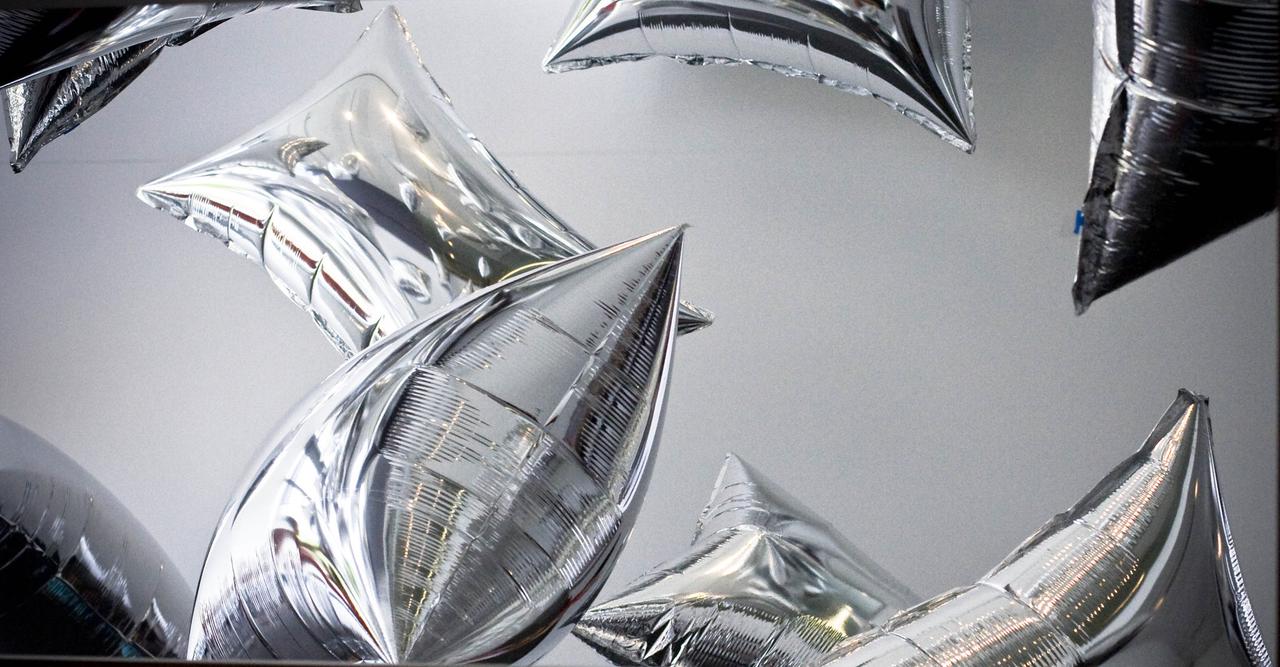
comedy sound effects). The playfully manufactured and entirely unnatural
Silver Clouds
(shown above) are plastic silver "pillows" filled with a careful mix of helium
and air - just like kids' party balloons. Naomi and I spent an entertaining
time bopping and booping them about the room and I, as a tuba player, couldn't
resist vigorously blowing underneath one of the pillows in a respiratory
busting and ultimately futile game of
keepie-uppie. We were told by one
of the staff that the pillows regularly escape,
especially in the presence of children (young or old). Of course, the museum
also contained versions of the iconic Warhol pieces, yet did so with sympathy
to the unfolding story as one explored the space. There was no "oh look, gotta
catch a photo of the Mona Lisa" or "lemme take a selfie with these Van Gough
Sunflowers" moment during our tour... although I suspect Warhol would have
sabotaged such contemporary theatrics, given half a chance.
Naomi and I discussed how we couldn't really imagine such provocative
playfulness at PyCon, nor any pointed subversions during the conference talks.
I was left in a thoughtful (i.e. grumpy) mood about our contemporary culture
contaminated by social media. Thanks to such exploitative technology, folks
don't have 15 minutes of fame, but an eternity of prompted performative
obscurity. If everyone is doing "famous", then nobody is famous and we're all
just sacrificing ourselves to assessment by algorithms.
Of course, Warhol has an angle on this.
One of the floors of the museum contains installations playing some of the many
screen tests
he shot in the mid-60's. I found myself asking "who's looking at who?" and then
I wondered about how individuals choose (or perhaps have no choice over) how to
present themselves. The personal branding, self obsessed "influencers", and
manipulative gaze of social media in contemporary culture came to mind. Are you
famous if you're on film or filmed if you're already famous? Warhol was playing
with the notion of "famous" long before coders thoughtlessly brought YouTube,
Twitter and Facebook into the world as an exercise in exploiting our collective
narcissism for the sake of shareholder value.
"I will if you will", I said to Naomi. She gamely took a seat and kicked off
the immortalization of four minutes of awkward "so now what do I do?"
exasperated looks into a fake film camera making faux whirring noises. As I
sat during my session, I counted in my head, listened to
Colonel Bogey with my inner
ear, and tried very hard to ignore the various passers-by (to varying degrees
of success). Ultimately, for four minutes I'd become another exhibit... a
delightful subversion of what it is to visit a museum. Bravo to the curators
for such an ironic trick. At the end, you're emailed a link to your
screen test... and I've embedded mine below. I bagsy this as a four minute
quota from my promised fifteen minutes of fame. I hope to make better use
of my remaining eleven minutes.
Here's the thing, I appear to be paying attention to you, as you pay
attention to me, but I'm not actually there! Perhaps Warhol would have
appreciated adding such a non-attentive video to an article about attention.
Another joyful contrast to PyCon was dinner with my buddy
Andrew Smith and
his partner Jan, along with Naomi, Guido and
Eric... all of whom (like me)
encountered Andrew as he was writing his latest book,
The Devil in the Stack.
The distinct lack of technical conversation was a breath of fresh air, and
Andrew and Jan were energetic and entertaining hosts.
In the week before PyCon and during PyCon itself I found myself reacting to the
conference with poetry (or, more accurately, doggerel). Feeling motivated by
the playfulness of the Warhol museum visit, and because an opportunity arose
during the meal, I was able to share some of these verses of varying
quality with such literary friends(!). I'm re-sharing them here so I can feel
they've somehow "escaped" into the world, and can take on a life of their
own... or simply pass into bewildered obscurity.
The first is a limerick about Guido. I've changed it from the version I read
out at the meal, since he explained that some Dutch I'd originally included
didn't quite make sense in the way I had hoped.
I was prompted by chatting with Guido at 2023's PyCon. I noticed he had covered
his name on his conference badge with a post-it note saying, "no selfies".
Guido is, of course, the inventor of Python.
No Selfies
Said Guido, a programmer Dutch,
“I really hate selfies. As such:
I might be your hero,
But to me it means zero.
Please leave me in peace, thanks so much”.
“But Guido you're really a saint,
When meeting you I feel quite faint.
I want to shake hands,
Rise above all the fans,
Be your best buddy without restraint”.
“Oh God! Please just make it stop!
These programmers really must drop,
The deluge of thanks,
Autographs and cranks,
'Else PyCon, for me, is a flop”.
I'm proud to say, everyone at dinner was politely bemused!
I didn't share this next poem at the dinner because it was still relatively
incomplete at the time.
Ode to a Data Scientist
This has 97 words, 12 lines and 3 verses,
Rhymes A-A-B-B in a scheme that traverses,
Through four lines per stanza, in compound time,
A measurable quantity expressed as a rhyme.
No doubt such patterns and figures reveal,
Aspects of things that stats un-conceal.
Yet these numeric collisions of aggregate stuff,
Are a diminished perspective that is not enough.
The observable facts such as these do not show,
Or reveal the subjective world that we know.
For beyond such detachment and detail we wend,
Through a universe to live in, embrace and transcend.
This is my plea for a more nuanced, expressive and felt view of the world.
Truth be told, I don't see myself as a programmer. In my mind's eye I'm a
musician who just happens to use code as their medium (reflect on
Charles Ives's famous question,
"my god, what has sound got to do with music?"). If you were to cut me open,
only my little toe would contain code, my uncoordinated left foot would perhaps
encompass my interest in philosophy, and my sprained ankle would be my
educational efforts. The rest would just be music.
I was in a puckish and annoyed mood when I wrote this final poem. I simply
wanted to poke fun at the barren world view of the tech bros.
The Plural Noun for Tech Bros
A herd of tech bros circle together,
bleating about the Pythonic weather.
Don't be the sheep cut off from the mass,
unable to pass,
as someone,
with something,
interesting
to
say...
Their mental masturbation ejaculates
ever-fruitless discourse:
Repackaged reportage from Hacker News,
Performative patronising technical reviews,
Name dropping semi-famous nerds,
An infinite garbage of computer-y words.
Detached and empty with no spark of life.
The real world ignored, to cut off its strife.
So clever they lack the intelligence to know,
We are vital and luminous souls who grow
Through connections and feelings and deep self revealings,
But their work fills the world with VC funded dealings.
Squeezing huge profits through inhumane code,
We're exploitable data points, with privacy to erode.
What do we call such a desperate crew?
A wank of tech bros, that'll do.
It felt good... nope... it felt great to read out such silliness to friends
~ paying attention to coding culture with my creative, playful and expressive
side while gleefully ignoring the performative moralising and tone policing
that often goes on in the (Victorian)
Python community. We desperately need writers, poets, artists, dancers,
sculptors, actors, architects, comedians and musicians in the world of coding,
if only to save us from the currently brain dead coding culture. Programming
is an art, so please come join in... we're not all thoughtlessly tone deaf
like Elon, charismatically challenged like Zuck or so easily forgettable like
those dudes, whose names escape me, that run Google.
The photographs I took while on the excellent guided tour should, I hope, speak
for themselves. Take your time browsing through them.
Thanks to the visit I'm reading a recent biography of Frank Lloyd Wright called
Plagued by Fire
by Paul Hendrickson. It's a quirky book about a deeply complicated man.
Frank Lloyd Wright was a surly, manipulative narcissist and his life was full
of dramatic twists and turns. He founded an influential
studio and school for architects,
was a major figure in the Prairie School
of architectural design, and (perhaps thanks to the way Falling Water captured
the public's imagination) had more than 400 commissions in the final three
decades of his life (he passed away at the age of 91).
Most paradoxically, given his arrogant, self-mythologising and dissonant
nature, he promoted an architectural philosophy called
organic architecture
that aimed to bring about harmony between human habitation and the natural
world. In his view, buildings should be at home in nature and grow "out of the
ground and into the light". Not only did organic architecture work with the
natural conditions of a site, but the process of design, construction, living
and maintaining was integral to the outlook, like stages in the life of a
living organism. Because of this dynamic outlook, Lloyd Wright believed that
"no organic building can ever be 'finished'" since it should respond to its
changing environment and needs of its occupants. He also emphasised the
importance of integrity - that a building should be "integral to site, integral
to environment and integral to the life of the inhabitants". Falling Water is
often cited as a classic example of this philosophy, articulated in his book
The Natural House.
My response to Falling Water was reflective: attentively being in the place
to assimilate and appreciate its presence, along with my own presence within
it. In the same way a live performance of music may create a time and place for
encountering certain feelings or attitudes, so this building had a
psychological impact on those who explored its rooms, transitions and placement
within nature.
As Joe, our mature yet sprightly guide, showed us around the property he
brought our attention to hidden details while telling the story of the life of
the house. He skilfully illustrated aspects of Lloyd Wright's philosophy. For
example, the notion of "destruction of the box" was mentioned several times:
the rooms were varying in shape, often open and flowed into each other. Joe
brought our attention to details relating to the fixtures, furniture, windows,
bathrooms, materials, lighting, the aural experience of the waterfall and
accessibility to the stream, sun and trees in the surrounding area. Everything
about this building was done consciously, with care and through a process of
attending to the way the parts "organically" cohered and emerged into a whole.
While chatting with the ever-thoughtful Martin, we both commented on how this
attitude to building structures was very different to the usual way we build
software. We agreed (to paraphrase our conversation) that coders,
"thoughtlessly bung features together and then
A/B test the hell out of it". To
me this attitude feels closer to
Le Corbusier's famous claim that,
"a house is a machine for living in". It's a contrasting outlook to Frank Lloyd
Wright, and pays attention to design for functionality, optimization and
efficiency. But I want to ask: who decides function, what needs optimising and
how optimisation takes place? I suspect most would point to the god-like
architect. Sadly, like the disempowerment of using products created in the
current coding culture, folks who inhabit such buildings don't get much of a
say, nor are they encouraged to change such "efficient" buildings to their
actual needs.
I quite like the sound of "organic software", although I'm unsure what it might
be. Right now it's a rough sketch in my head of an attitude or way of paying
attention to the creative act of writing code. Perhaps that's the nub of it:
organic software empowers folks to pay attention, change and control the code
in their digital life so it reflects their unique and precious presence in the
world.
I can't help but wonder that a whole is never the same as the sum of its parts,
be that a building, a piece of music or even software. Rather, there are simply
different ways to pay attention to the world, and by focusing on the whole or
parts thereof, each illuminates the other depending on the sort of attention we
pay to it. The world is independent of us, yet how we pay attention to the
world reveals the world to us in a certain sort of way. Such creative
attention, as I have mentioned before, is a potent and
fluid process of encountering, understanding and expressing. We discern the
universe and also change the universe through our discerning and reacting. How
we choose to pay attention (for it is certainly a choice), is a significant
creative and moral act: it both makes and enlarges the world.
An inevitable musical metaphor illustrates what I mean. As a performer I could
just play in a mechanical-yet-very-accurate manner, only paying attention to
the formal and technical aspects of a piece. Yet this is clearly a diminished
performance because of the absence of attention to expression, feeling or
"ensemble" (the connection with other performers and the audience), those
aspects of performance that fall under the realm of musicianship. The former
attention to musical technique is only worthwhile if the latter attention to
musicianship is present. To be a good musician you need to bring to bear many
different ways of paying attention, each of which contributes to a new unique
entity containing and combining all these integrated aspects.
We pay attention in this creative manner because it gives us an enlarged,
affirmative and stimulating way to participate in and transform the universe.
Put bluntly, it brings meaning to life.
As I said at the beginning...
To what we pay attention is important. How we pay attention is equally
consequential but often unconscious. Considering why we pay attention is
perhaps most significant ~ an engaging, poignant and sadly neglected
opportunity for self-examination.
I sincerely hope we all find a way to pay attention in a more compassionate,
creative and magnified manner.